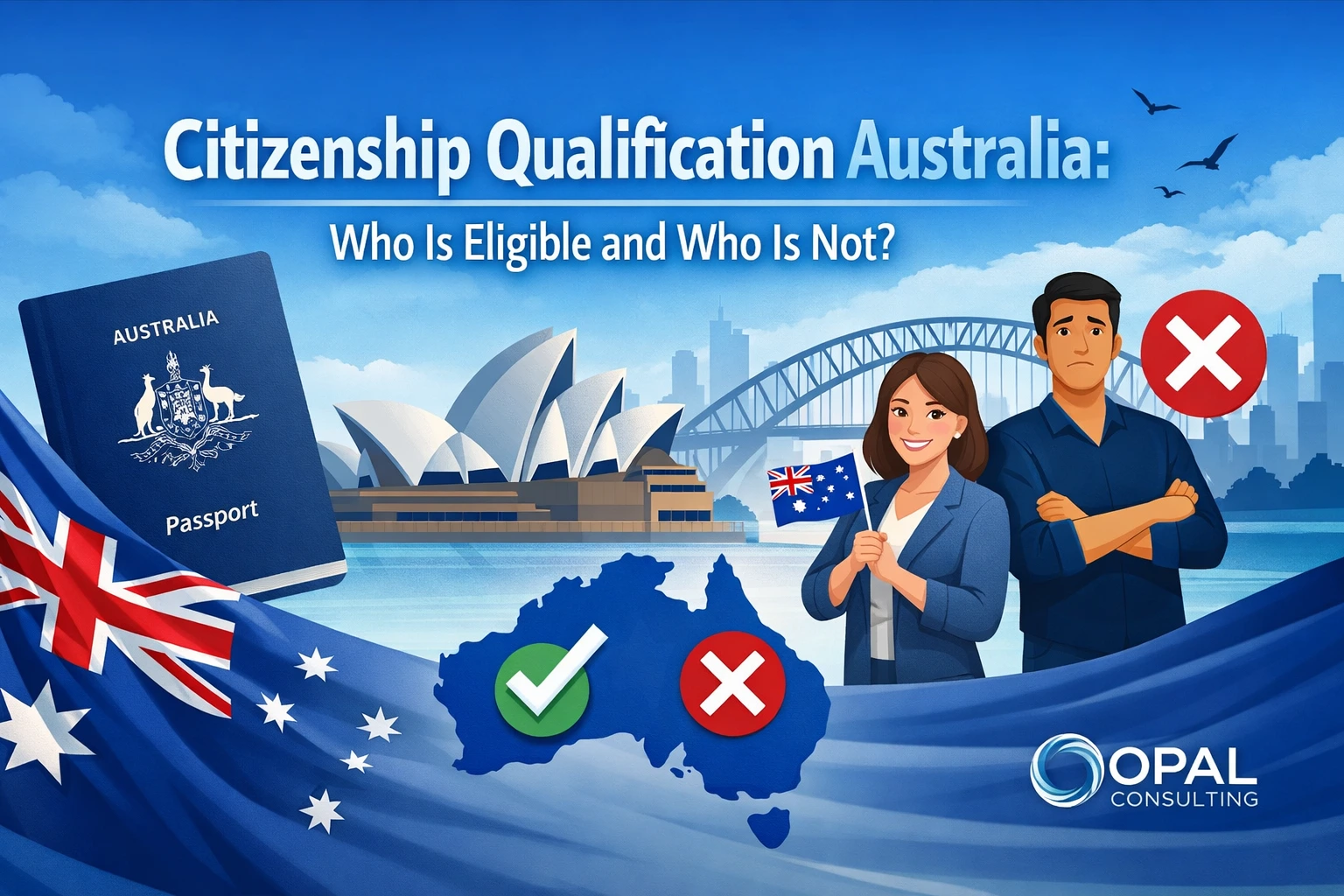
Citizenship Qualification Australia: Who Is Eligible and Who Is Not?
February 17, 2026

If you have been living in Australia on a permanent visa and wondering whether you now qualify for citizenship, you are not alone. Every year, thousands of permanent residents reach that milestone and start asking: do I meet the citizenship qualification Australia rules?
The short answer is: it depends on your visa, your time in Australia, your character record, and your pathway. This guide breaks down every criterion in plain English — whether you qualify, why you might not, and exactly what you need to do next.
Need personalised advice on your case? Our registered migration agents at Opal Consulting are here to help.
Most migrants apply for citizenship through conferral — the formal process of being granted citizenship after living in Australia on a permanent visa. This is different from citizenship by birth or by descent.
To qualify, you must satisfy five core criteria at the time you apply:
Failing even one of these criteria means your application will be refused. Here is what each one actually means.
This is the most common reason applications fail. You must have lived lawfully in Australia for four years immediately before you apply. Within those four years:
Counting your days correctly is critical. Use the DHA Residence Calculator to verify your dates before you apply. Our team can also review your travel history and confirm your eligibility window.
Important note: The COVID-era absence concessions ended. Time spent outside Australia during that period now counts under standard rules.
Below is a summary of citizenship qualifications in Australia across all common applicant groups:
|
Applicant Type |
Key Citizenship Qualification (Australia) |
Test / English Required? |
|
Adult (18–59) |
4 years lawful residence; 12 months as PR; absences ≤12 months over 4 years and ≤90 days in final year | Yes — both required |
|
Aged 60+ |
Same residency; good character required |
Exempt from test and English |
|
Children under 16 |
Must hold PR; must live with a responsible parent or guardian who is applying or already a citizen |
Exempt |
|
By Descent |
Born overseas to an Australian citizen parent; no residency period required |
N/A |
|
NZ SCV Holders |
Treated as PR; same 4-year residency rules apply |
Yes — standard |
| Reacquisition | Prove prior citizenship loss (e.g., naturalisation abroad); good character required |
Varies by case |
Just as important as knowing who qualifies is knowing who will be refused. The DHA will reject your application if you:
If you have had a visa refusal or criminal matter in your history, speak to one of our migration agents before applying. A character concern does not always result in a refusal — but it must be handled correctly.
Every applicant aged 16 and over must meet the good character requirement. The DHA assesses:
You must provide police clearance certificates from every country where you have lived for 12 months or more since turning 16. This includes Australia (AFP check) and your home country.
If your application gets refused on character grounds, you can appeal to the Administrative Appeals Tribunal (AAT). However, the window is tight and the evidence required is substantial. Early legal advice from our citizenship specialists can significantly improve your outcome.
Before DHA approves your application, you will sit a citizenship test at an approved centre. Here is what to expect:
Who is exempt? Applicants under 18, those aged 60 and over, and applicants with a permanent physical or cognitive impairment that prevents them from understanding the test do not need to sit it.
Around 20% of applicants fail the test on their first attempt. The official practice tests on the DHA website are your best preparation tool.
Learn More: New Rules For 482 Visa to Permanent Residency
Once you confirm you meet the citizenship requirements in Australia, follow these steps:
Use the DHA Citizenship Wizard and Residence Calculator to verify your residency dates. Alternatively, our eligibility check service gives you a personalised assessment within 24 hours.
All citizenship applications go through ImmiAccount at immi.homeaffairs.gov.au. You will need to register with a valid email and set up multi-factor authentication (MFA). Keep your login details secure — you will use this account to track your application throughout the process.
Complete Form 1300t or 119 online through ImmiAccount. If you are applying for family members at the same time (including children), include them in the same application. The current fees for 2026 are approximately AUD 540 for adults, with concessions available for children and low-income applicants. Note that fees are non-refundable — only apply once you are certain you meet all criteria.
After lodging, DHA invites you to complete biometrics (fingerprints and photo) and book your test. This typically happens within 6 to 12 months of lodgement. Book your test online through ImmiAccount once invited.
Once approved, your local council invites you to a citizenship ceremony where you make the Australian Citizenship Pledge. After the ceremony, you receive your citizenship certificate. Most applications are processed within 6 to 8 months, with 90% of straightforward applications finalised within that window in recent DHA data.
After gaining citizenship, you can apply for an Australian passport or explore family sponsorship options through our team.
Many permanent residents wonder whether it is worth applying for citizenship at all. Here is what changes when you move from PR to citizenship in Australia:
If you are not yet a permanent resident, your citizenship journey starts with obtaining a PR visa. Many skilled migrants follow this pathway:
The 491 provisional visa leads to PR via the subclass 191 visa after 3 years living and working in a regional area. From there, your path to citizenship follows the standard citizenship application in Australia process above.
Not sure where you sit on the points test? Our migration team can review your skills assessment and identify the fastest route to PR and then citizenship.
Citizenship is not just a legal status — it is a long-term life decision. Getting the application right the first time matters, especially if there are complications in your history.
At Opal Consulting, our MARA-registered migration agents have guided clients through the Australian citizenship process for over 15 years. We review your eligibility, prepare your documents, and manage your application from start to ceremony.
You can apply as soon as you have lived lawfully in Australia for 4 years, with the last 12 months as a permanent resident, and meet all other criteria. Use the DHA Residence Calculator to find your exact eligibility date.
No. Marrying an Australian citizen does not give you automatic citizenship. It may assist you in obtaining a partner visa leading to PR, but you still need to meet all standard citizenship qualifications in Australia from that point forward.
Since 20 August 1986, being born in Australia does not automatically grant citizenship. You gain citizenship at birth only if at least one parent is an Australian citizen or permanent resident at the time of your birth.
The current adult fee is approximately AUD 540. Concessional rates apply for children and some low-income applicants. Fees are set by the government and reviewed periodically — confirm the current rate on the DHA website before applying.
Yes. Australia formally permits dual citizenship. However, your home country may not — so check your country of origin’s laws before applying. Some nationalities automatically lose their original citizenship upon naturalisation in another country.
February 17, 2026

February 10, 2026


January 6, 2026
Join our FB Group page for regular updates on Immigration changes